
Did you ever get the feeling someone or something was watching you? As blue skies sink into an orange-purple haze, something about this dusky, still air signals to creatures of the night that it’s time to wander out.
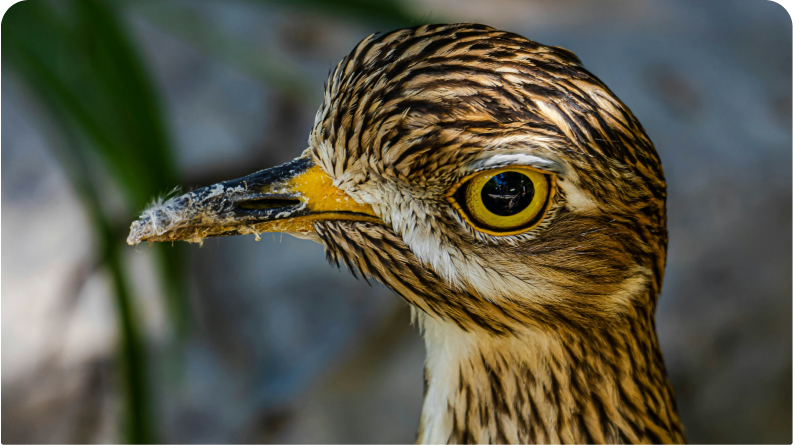
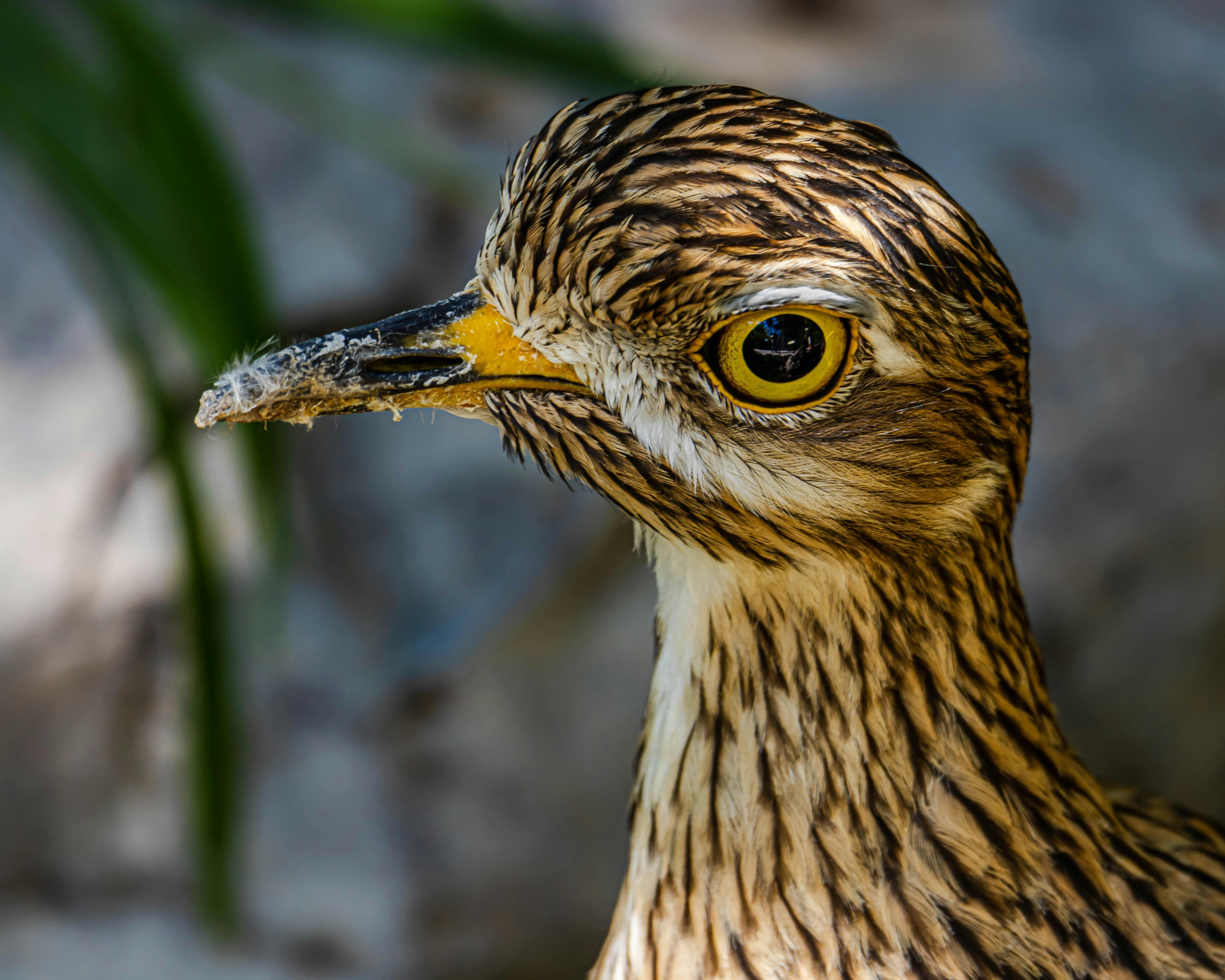
Emerging from the shadows, a knobbly-kneed, two-footed onlooker stands more than half a metre tall. Atop this elegant, feathered figure is an uncomfortable yellow stare that sets your hair on end. The Bush Stone-curlew, motionless as a statue, calculates your movements. Its thick beak protrudes just long enough to make you uneasy, before rousing the neighbourhood’s soundscape with a harrowing call — weeeeeeeelow. Once more, it’s the curlews’ watch.
The Bush Stone-curlew is renowned for its haunting, almost other-worldly presence. They tiptoe with great stealth through the night, pausing in a fossil-like stillness that raises goosebumps with each turn of their reptilian eye. It’s not without reason that for many First Nations communities these birds are messengers of death or grief, their wailing, sombre call being a ‘cry for lost souls‘.
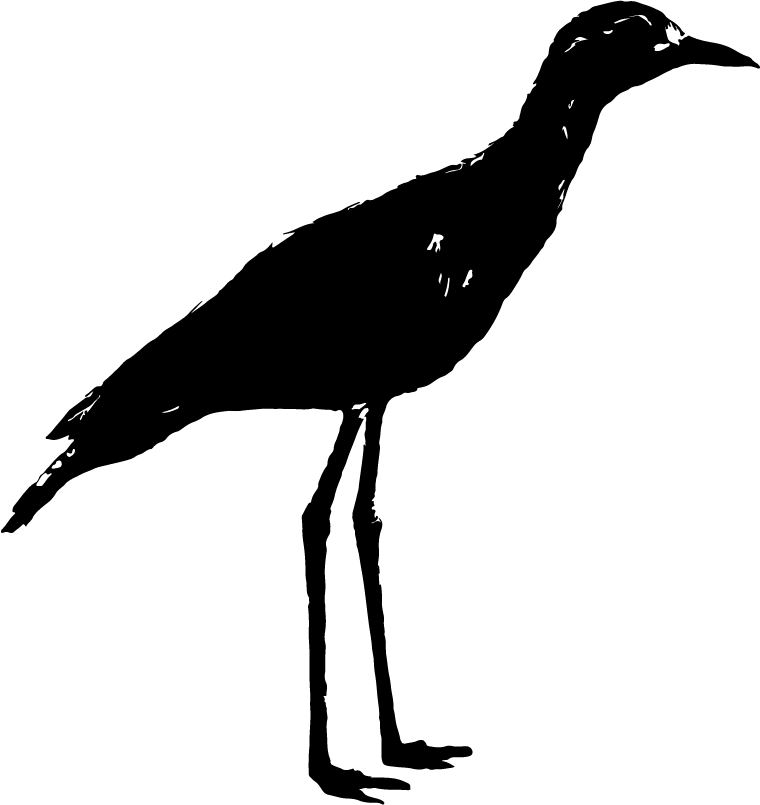
Bush Stone-curlews resonate with humans in a unique way that’s reflected in their diverse names. From ‘Weelo’ or ‘Willaroo’ after the sound they make, to ‘Angelbird’ and even ‘Murderbird’. They can also be called ‘Thick Knees’ after their knobbly joint protruding from their long, spindly chicken legs that appears to uncomfortably bend backwards. Strictly, though, this joint is more closely equivalent to an ankle — their actual knee joint is hidden from sight. But judging human eyes and folklores aside, what lays behind the mystery of this unusual bird?
Bush Stone-curlews are shorebirds, more closely related to oyster catchers and Hooded Plovers than the curlews they are named after. They share seven other relatives within the stone-curlew family, found in Europe, Africa, South Asia, and one other Australian native, known as the Beach Stone-curlew, that lives in coastal zones. Mostly, these ground-dwelling birds enjoy habitats of bare, semi-arid, stony open ground. But tropical hideouts also include mangroves, mudflats, salt marshes and rainforest fringes. Their large yellow eye is well adapted for hunting insects, such as beetles and weevils, and even lizards, amongst the darkness of night.
Stone-curlews live around 15 years (but can live up to 30) and mate for life, making courtship rituals a rare sighting. For an otherwise shy bird of the shadows, this occasion is a curious dance of male prowess. With their impressive 80-centimetre wingspan fully outstretched, males will position their tails upright and tilt their neck ever so slightly forward, like a ballet dancer’s arabesque, all while stamping their feet and wistfully singing out to a potential match.
***
Curlew in the city
In Brisbane City’s modern concrete jungle, these peculiar birds have adapted surprisingly well to the sprawling, suburban architecture. Their ghostly presence can be found lurking down your street, in public parks and playgrounds, taking advantage of insects attracted by the bright city lights, and even patrolling the occasional bottle shop. The nightly wailing echoes between a breeding pair is a regular, soulful tune amongst the humdrum of the city soundscape.
A ‘grounds team’ of hungry Stone-curlews would reliably mark the end of my weekly soccer practices. Ushering players off the pitch, the birds found the closely mown playing field a desirable spot for dinner. For this early-to-bed city, curlews are the nighttime neighbourhood watch, but sadly, suburban Queensland may be a rare haven.
Just across the state border, curlew populations have become increasingly scarce across much of Australia’s Southeast. In New South Wales, Bush Stone-curlews are listed as Endangered, in South Australia, Vulnerable, while in Victoria, they’re now Critically Endangered, with some population counts estimating numbers as low as 300 across the entire state.
Stone-curlew numbers have diminished as their habitats have been lost to urbanisation, agriculture and logging. Inappropriate fire regimes reduce the understorey vegetation they need for shelter and food, while land clearing (like removal of fallen timber) takes away vital safety hideouts and places to nest. For an animal whose fight-or-flight response is to freeze, lie down, and hope not to be seen, cryptic cover is essential. But with 85 per cent of their habitat now lost across Victoria, curlews are exposed and vulnerable to predation.
Introduced predators — European red foxes and feral cats — are the main cause of nesting failures. Stone-curlews lay just one or two eggs a year, and unfortunately, they make for an easy dinner. Eggs are simply laid on the floor, nestled amongst a few fallen leaves or twigs on sparse open ground that allows parents to survey ongoings across a large perimeter. Other introduced species, like rabbits and deer, cause problems by increasing competition for resources that become increasingly hard to find as climate change-induced droughts and floods become more common.
But the Bush Stone-curlews’ calls have not gone unheard. Since 2019, the Odonata Foundation in Victoria have been working to rebuild stone-curlew populations through active breeding and release programmes, as well as creating large-scale, predator-free sanctuaries, including Orana Park near Bendigo and Mount Rothwell, west of Melbourne.
Their latest project includes Phillip Island, home of the world’s largest colony of Little Penguins. Beginning in 2024, the Little Penguins now share this fox-free haven with the first round of stone-curlew introductions — the first time stone-curlews have been seen on the island since the 1970s. Working together with the Australian National University (ANU) and Phillip Island Nature Parks, each curlew was fitted with its own ‘GPS backpack’. This allows teams to study curlew travel patterns and behaviour to help tweak future reintroduction programmes and conservation strategies.
***
An island home
Given the Bush Stone-curlews threatened status across much of the country, how is it that around Brisbane, Australia’s third most populated city, the bird still thrives?
On Coochiemudlo Island in Moreton Bay, just a stone’s throw from the Brisbane mainland, the local stone-curlew population has been monitored since 1997. On this tiny island, it’s not uncommon to observe flocks of around 50 birds. Once a year, on a February afternoon, teams of citizen scientists come together during golden hour for the Redland City Council Curlew Count, followed by a sausage sizzle once the counting’s done.
In 2026, the survey counted nearly 250 curlews over the 400-hectare area — comparable to some population estimates for the entire state of Victoria. However, over the last few years, Coochiemudlo’s numbers have peaked, indicating the island is now at carrying capacity. But researchers hypothesise that the island may be an important source population for less secure populations on the mainland.
The long-running survey has highlighted a strange trend. On Coochiemudlo, stone-curlew numbers have increased with the number of urban developments. Since the surveys began, the island’s human population has almost doubled and the total number of developments up by 18 per cent. It appears, for stone-curlews at least, that ‘human-modified landscapes with low levels of regular disturbance’ increase available habitat.
On Coochie, dense shrubland has been replaced by parks and private gardens. These open areas with short-cut grass not only help with foraging but also allow the birds a full view of potential threats, all from the comfort of sitting down. House lights and old septic tanks attract a wealth of tasty insects like earthworms, beetles and bush cockroaches, whilst the raised-up houses provide protective refuges.
For Coochiemudlo, Bush Stone-curlews are part of the island’s identity. The curlews here may not only be caught stopping traffic as they cross the road with their delicate chicks, but also feature in beautiful murals, like on the wall of the aptly named Curlew Café. One individual is a regular at the island’s beach bar & grill. This opportunist is no ‘angelbird’, but not a ‘murderbird’ either — perhaps just a cheeky chancer.
Though the island’s human population has grown in recent years, it’s far from a concrete metropolis. Many of the houses have vacant lots beside them that serve as important environmental corridors, and a fair number lie empty except for resident curlews camped out in the gardens. Researchers predict curlew numbers would soon reverse if enough of these empty plots were built upon.
For now, Brisbane remains a relatively green city, with large parks even amongst its central districts. But as the city’s population grows, development is on the rise. However, this doesn’t have to be at odds with its resident curlews or other ground-dwelling birds. Perhaps Coochiemudlo Island has something to teach us about the kinds of natural corridors and urban spaces curlews can utilise. Ideas like these may be integrated into nature-positive approaches to urban planning.
***
Coming home
In the 1970s, Bush Stone-curlews went locally extinct within the Australian Capital Territory for over 40 years. But in 2014, they were reintroduced to Mulligans Flat Woodland Sanctuary, where their populations have steadily grown. And now, once again, some Canberra residents have been fortunate enough to catch nighttime sightings of these birds foraging along their streets. Their unique wailing notes stir the city’s sleepy streets once more, resonating with a call of hope to Australia’s other curlew reintroduction programmes.
In Brisbane, that the Bush Stone-curlew has successfully adapted to live within this urban realm feels like an ecological wonder we ought to savour. I’ll forgive them their foreboding air, for I’d much rather feel the shiver of their stare, than the hollow feel of a metropolis ghost land, with them not there.
So, when the sun lifts the cloak of night, the curlews scuttle off somewhere secret to roost. Let the humans busy about the day, at least until sundown, before the curlews’ watch begins, again.